Why Some Students Understand a Topic but Still Perform Poorly in Exams
Many students feel they understand the lesson but get poor marks in the exam. This article explains the common reasons, like feeling of understanding, no practice recall, time pressure and exam stress. It also gives simple steps students and parents can use to fix the problem.
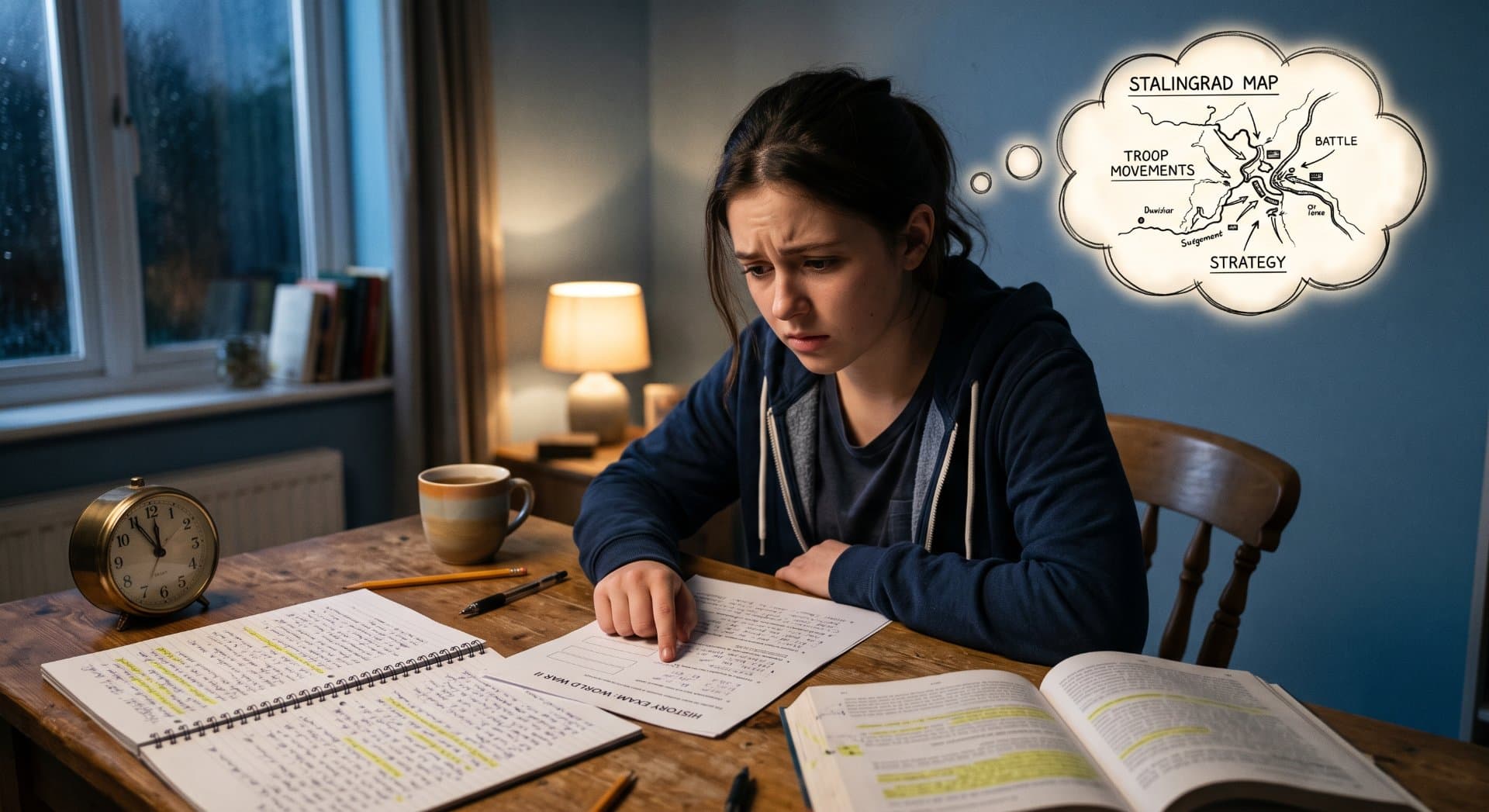
A student sits in class, follows the teacher, nods at every point, even explains the topic to a friend. Then the exam comes and the marks are low. Student feels confused and sometimes feels stupid. Parents also get confused because "he knows everything at home."
This is a very common problem and most of the time it is not about intelligence. Understanding a topic and answering an exam question are two different things. This article explains why the gap happens and what you can do about it.
The Problem
Understanding means you can follow the explanation when somebody is showing it to you. Exam needs something else. You must remember the thing, pick the right part and write it clearly, alone, with the clock running and no teacher to help.
So a student can truly understand the lesson and still not be ready for the exam. The skill needed for exam was never practiced.
Why It Happens
1. Feeling of understanding is not same as knowing
Many students read the notes again and again. It feels good because everything looks familiar. But familiar is not the same as remembered. Research shows students often think rereading works better than testing themselves, even when evidence says the opposite. Studies found that students tend to prefer and rate rereading higher, though it is weaker for long-term learning. Another summary says students who only reread often do worse than they expect, while students who take practice tests usually do better than they expect.
So the student is not lying or lazy. The brain is just giving a false signal of "I know this."
2. Never practiced taking the information out
Studying is mostly putting information in. Exam is taking it out. If you never practice taking it out, it feels hard on the exam day. Practicing recall is difficult while studying and you make more mistakes. But that extra effort is linked with much better memory after days or weeks. A study on real exams also found that students who used recall on their own had better exam performance, while rereading showed no relation to exam performance.
3. Understanding is shallow
Sometimes the student understands only when the teacher or the book is helping. When the support is gone, the understanding falls down. One article on this topic describes it as surface-level understanding that collapses under the structured demands of a test. A simple check: close the book and try to explain the topic from zero. If you get stuck quickly, the understanding was not deep yet.
4. Exam style is different from class style
In class, questions are easy and slow. In exam, questions can be tricky, mixed and timed. Some students know the topic but never solved questions in exam format. They lose time on the first questions, then rush the rest. Others know the answer but write it badly, miss key words or skip a part of the question.
5. Exam stress
Stress can really affect marks, but the story is not so simple. Some research says worry can fill up the working memory, the mental space where we think, so it becomes harder to use what we know. But other research found something interesting. When researchers looked at mock exam scores, test anxiety no longer predicted final exam scores, which suggests anxious students may have gone into the exam with less knowledge because anxiety made preparation harder.
So stress may hurt in two places: during the exam and also much earlier when the student is preparing. That is why only "stay calm" advice on the exam morning usually does not fix much.
What Usually Goes Wrong
Reading the same notes again and again and calling it revision
Highlighting everything and never closing the book
Studying the night before, with no gap between sessions
Only solving examples that the teacher already solved
Never practicing with a timer
Not checking past papers or the exam pattern
Not reading the question properly in the exam
Feeling good after class and not testing the memory again after few days
The Solution
You do not need a big plan. Start with these steps.
Step 1: Close the book and write what you remember.
After you study a topic, close everything. Write or say everything you remember on a blank paper. Then open the notes and check what you missed. The missed parts are exactly what you need to study again.
Step 2: Make your own questions.
If you don't have practice tests, make some. One short study summary says that making your own questions can give the same benefit as taking a test. Use the headings of the chapter and turn them into questions.
Step 3: Space it out.
Don't study one topic for four hours and then leave it. Study it today, then again after two days, then after a week. Short and repeated is better than long and once.
Step 4: Solve past papers with a timer.
Do at least some of them in exam condition. No phone, no notes, same time limit. After finishing, check where you lost marks. Was it not knowing? Slow speed? Careless mistake? Each one has a different fix.
Step 5: Explain it without help.
Try to teach the topic to someone or just speak it out loud alone. If you cannot explain a step, you do not understand that step yet.
Step 6: Practice reading the question.
Underline what the question really asks: explain, compare, calculate or list. Many marks are lost because students answer a different question from the one asked.
Step 7: Start early if stress is a problem.
Because stress seems to affect preparation also, begin revision early and do small, easy practice sessions often. Slowly the exam feels less scary because it is familiar. On the exam day, start with the questions you know best so you get some confidence.
What to Check
How do you know it is working?
You can write a full answer on a topic from memory, without looking.
Your practice test score goes up over two or three weeks.
You finish the practice paper in time or almost.
Your mistakes become smaller. Less "I forgot everything," more "I made a small calculation error."
If the score does not move at all, look at what type of mistakes you make. That tells you what to change.
When the Solution May Not Work
Sometimes study method is not the main problem.
If the student panics badly, cannot sleep or goes blank even on easy practice questions, talk to a teacher, school counselor or a doctor. This needs more than study tips.
If the student has trouble reading, writing or focusing even in normal life, a teacher or specialist can check for a learning difficulty.
If the student really does not understand the basics of the subject, practice tests alone will not fix it. Go back and fix the base first.
Poor teaching, a wrong syllabus or a very different exam pattern can also cause low marks. Then the student needs the right material, not more effort.
What to Do Now
Pick one topic you studied this week. Close your book and write everything you remember. Check it. Do this again in three days. This one small habit tells you very fast whether you really know the topic or only feel like you know it.
FAQs
Why do I understand in class but forget in the exam?
In class, the teacher is helping you and everything is fresh. In exam, you must take the information from memory alone. If you never practiced that, it is hard. Recall practice and past papers fix this.
Is rereading notes a bad idea?
Not completely. It is okay for a first look. The problem is when it is the only method. Mix it with self-testing and rereading will be more useful.
Is it exam stress or lack of knowledge?
Try a simple test. Take a practice paper at home, with timer and no notes. If you also score low at home, knowledge gap is likely. If you score well at home and low in the real exam, stress or exam habits may be the bigger part. It can also be both.
How early should I start practice tests?
As early as you can, not only at the end. Start with small self-quizzes after each topic and full past papers closer to the exam.
Can parents help?
Yes. Instead of asking "did you study?", ask the child to explain the topic or answer some questions without the book. It is a more honest check and it is also good practice.
Will this work for all subjects?
It works well for most subjects. For maths and science, practice solving new problems, not only reading solved examples. For essay subjects, practice writing short answers from memory.
Share this story with your network
Direct citation and sharing for this investigative report.

View Point Spot
Editor-in-Chief
View Point Spot is a place for ideas, stories, insights and different points of view. We share useful, interesting and easy-to-understand content across a wide range of topics, helping readers discover something new and see the world from a different perspective.
Related Coverage & Dispatches
More in Education →
Should Students Use AI for Learning?
This article looks at whether students should use AI for study. It explains how AI can help learning and how it can hurt it, using 2025 and 2026 research. It ends with simple rules, steps and a quick check for students, parents and teachers.
View Point Spot1 hours ago
How AI Is Changing What Students Need to Learn in 2026
AI is changing which skills matter for students. See what still needs to be learned by hand, what is new and how to use AI without losing your thinking skills.
View Point Spot3 days ago
What Do the Warning Lights on Your Car Dashboard Really Mean?
A simple guide to car dashboard warning lights and symbols. Learn what each color and icon means and what to do when one turns on.
 Afshan YasmeenSep 6, 2026
Reader Discussion (0)
No comments yet. Be the first to start the discussion!