How AI Agents Are Changing Software Development
A clear look at how AI agents are reshaping software development, what they actually do, where they help, where they fail and what it means for developers.
Software development has quietly gone through one of its biggest shifts in years and it didn't happen with a single big announcement. It happened tool by tool, release by release. A few years ago, "AI help" for coding meant autocomplete that finished your line of code. Now it means something closer to handing off a whole task "add authentication, update the API, write the tests, fix whatever breaks" and having a system actually go do it.
That's the difference between an AI assistant and an AI agent and it's the reason so many teams are rethinking how they build software. This article breaks down what's actually changed, how these agents work day to day, where they genuinely help, where they still fall short and what it means if you're a developer trying to figure out where you fit in.
From Autocomplete to Agents: What Actually Changed
Early AI coding tools worked like a smarter autocomplete. You typed, the tool suggested the next few lines and you accepted or ignored them. Useful, but the human was doing all the driving deciding what to build, opening files, running tests, fixing errors.
AI coding agents work differently. Instead of reacting to what you're typing right now, they can take a goal, break it into steps and carry those steps out largely on their own: reading through a codebase to understand how it's structured, editing multiple files, running the test suite, checking whether the output actually works and adjusting when it doesn't.
Industry analysts have started calling this shift "agentic software development" moving from AI that assists a developer to AI that participates directly across the software development lifecycle, not just at the code-writing step. According to Anthropic's 2026 State of AI Agents report, more than 9 in 10 organizations now use AI to assist with coding and the large majority have moved past experimentation into using AI coding agents for production code. A meaningful share of organizations reportedly over 40% say they now trust these agents to lead development work with a human still reviewing along the way.
That "human still reviewing" part matters. It's not that agents are replacing developers wholesale. It's that the day-to-day job is shifting from writing every line yourself to directing, checking and correcting a system that writes a lot of it for you.
How AI Coding Agents Actually Work
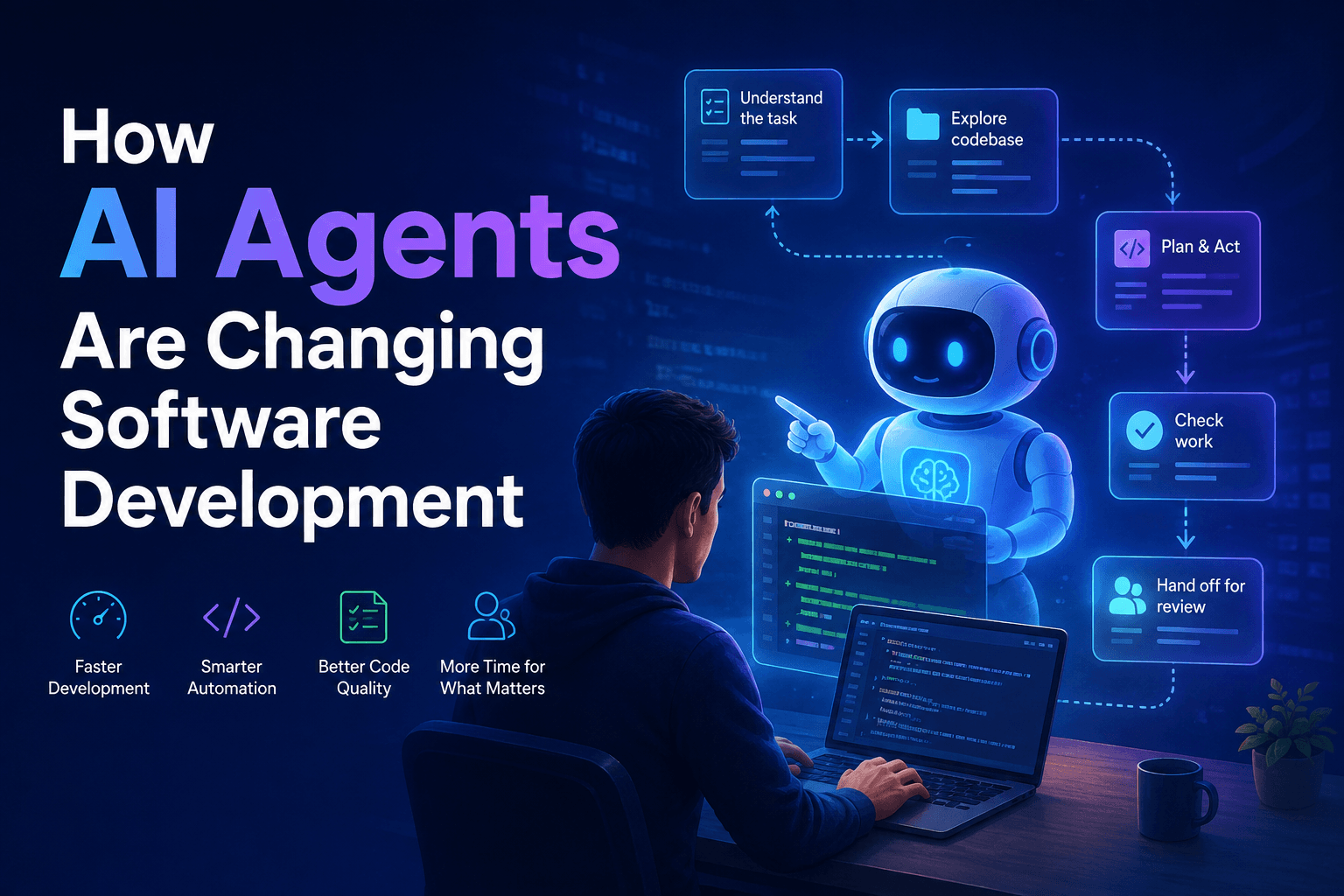
Most modern coding agents follow a loop rather than a single request-and-response exchange:
Understand the task. The developer describes a goal in plain language a feature to build, a bug to fix, a refactor to carry out.
Explore the codebase. Rather than relying only on a fixed snapshot of the project, the agent actively looks through relevant files, similar to how a developer would go searching for the right place to make a change.
Plan and act. It breaks the goal into smaller steps, then starts editing files, running commands and calling other tools it has access to.
Check its own work. Many agents run tests, linters or build steps to see if what they did actually works and loop back to fix problems before handing results to a person.
Hand off for review. The output often a pull request or a working branch goes to a developer to review, adjust or approve.
This "execution loop" is what separates an agent from older AI tools and it's also why agents can now run for extended stretches with less supervision, sometimes working in the background while a developer does something else entirely.
Three broad categories of tools have emerged around this pattern:
Command-line agents that live in the terminal, close to where builds, tests and deployments already happen. These tend to be the most flexible and the easiest to customize.
IDE-native agents built directly into the code editor, designed to keep developers in their normal workflow instead of switching between a chat window and their files.
Autonomous, delegated agents that take on a task more like a junior engineer would working independently in a separate environment and reporting back once the work is done, rather than sitting alongside the developer step by step.
Different teams reach for different categories depending on the job: a quick, supervised fix might go through an IDE-native agent, while a larger, well-defined task might get delegated entirely.
Where AI Agents Genuinely Help
It's worth separating the parts of this shift that are real from the parts that are still marketing.
Faster handling of repetitive work. Boilerplate code, routine refactors, writing tests for existing functions, updating documentation these are exactly the kind of well-defined, low-ambiguity tasks agents handle well. Teams report completing some of these tasks in a fraction of the time it used to take.
Faster onboarding to unfamiliar code. Because agents can explore a codebase and explain what they find, new developers (or developers moving into a part of the system they don't know well) can get oriented faster than reading through everything manually.
More time for architecture and judgment. When the mechanical parts of coding take less time, developers have more room to think about design decisions, trade-offs and the "should we build this at all" questions that actually determine whether software succeeds.
Multi-step task handling. Give an agent a broader instruction "add this feature and make sure existing tests still pass" and it can often carry that through several connected steps without needing a prompt for each one.
None of this means agents are doing all the thinking. Research on how AI use is actually changing developer behavior points to a shift toward what's being called "supervisory engineering work" professionals spending more of their time verifying and guiding AI output rather than typing it from scratch. The developer's role isn't disappearing; it's moving up a level.
Where AI Agents Still Fall Short
This is the part that gets left out of a lot of the hype and it matters just as much.
Correct and secure code aren't guaranteed. Independent benchmarking on AI-generated code security has found that even top-performing models produce code that's both correct and secure only a little more than half the time without specific security prompting and that figure only rises modestly even when the model is explicitly told to watch for known vulnerabilities. More code generated at the same error rate simply means more bugs to catch.
Agents can only be trusted with a limited slice of the work. Reporting on agentic coding trends suggests developers now use AI for a majority of their day-to-day coding work, but can only fully hand off a small portion of tasks roughly the 0–20% range without needing to check or guide the result. The rest still needs a human in the loop.
New security exposure comes with new autonomy. Giving an agent the ability to read files, run commands and call external tools also gives it a bigger "blast radius" if something goes wrong. Security researchers have documented real cases of prompt injection where content the agent reads (a web page, a file, an issue comment) contains hidden instructions that trick it into taking unintended actions. There have also been documented supply-chain issues where third-party plugins or "skills" for coding agents carried malicious code, since those extensions typically run with the same permissions as the agent itself.
Irreversible actions are risky without guardrails. An agent that can delete files, modify a database or push to production doesn't pause to double-check the way a cautious developer might. If its judgment is wrong on an action that can't be undone, there's often no easy way back. This is why security teams increasingly recommend requiring explicit human approval before an agent can take any action that can't be reversed.
Governance is still catching up. As more agents get plugged into real systems Salesforce's 2026 Connectivity Benchmark Report puts the average company at around a dozen AI agents in use, with a large share operating with little oversight the need for clear permissions, coding standards and review processes is becoming as important as the productivity gains themselves.
What This Means for How Software Gets Built
Put together, the honest picture looks less like "AI replaces developers" and more like "the job of a developer is being redrawn."
Then Now Write most code by hand, line by line Describe the goal, review and adjust what the agent produces. Debugging is mostly manualAgents run tests and fix some issues themselves, developer verifies the fix. Learning a new codebase takes time reading files. Agent can summarize and navigate the codebase alongside you. Code review focuses on style and logicCode review increasingly also checks for AI-introduced security issues. Deployment is a manual, deliberate stepSome agents can open pull requests or deploy directly, under set permissions
Communication and specification skills are becoming just as important as raw coding ability. Being able to describe a task clearly, set the right boundaries for what an agent can and can't do and catch a subtly wrong solution are all becoming core parts of the job not side skills.
Common Questions
Will AI agents replace software developers? The evidence so far points toward transformation rather than replacement. Agents handle a growing share of the mechanical work, but they still can't reliably judge trade-offs, understand business context or catch every security issue on their own. Developers are shifting toward reviewing, directing and validating AI-generated work rather than being replaced by it.
Are AI-generated code and AI agent actions safe to use in production? Not automatically. Independent testing shows AI-generated code is measurably more prone to certain security flaws than code written with security in mind from the start and autonomous agents introduce additional risks around permissions and irreversible actions. Teams using agents in production generally need stronger review processes, not fewer.
Do I need to learn a new set of tools to work with AI coding agents? Not necessarily new programming languages, but yes to new habits writing clear task descriptions, reviewing AI-generated pull requests carefully and understanding what permissions an agent has been given. The tools themselves (terminal-based agents, IDE-integrated agents, autonomous delegated agents) vary and most teams end up using a mix depending on the task.
What's the difference between "vibe coding" and agentic coding? "Vibe coding" generally refers to a more casual, prompt-and-accept style of working with AI where a developer leans heavily on suggestions with light review. Agentic coding refers to a more structured process where an agent plans, executes and validates multi-step work, typically with defined checkpoints for human review. The two overlap, but agentic coding is generally associated with more process and oversight around what the AI is allowed to do.
The Bottom Line
AI agents haven't eliminated the need for skilled developers if anything, they've raised the value of good judgment, clear thinking and the ability to catch what a machine gets wrong. What's changed is where developers spend their time: less on typing out routine code, more on deciding what should be built, reviewing what the agent produced and making sure the result is actually secure and correct before it ships.
If you're evaluating whether to bring AI agents deeper into your own development process, the practical starting point isn't "which tool is best" it's setting clear boundaries on what an agent is allowed to do on its own and building the review habits to catch it when it gets something wrong.
Related Topics:
Share this story with your network
Direct citation and sharing for this investigative report.

Noman Maken
Senior Software Engineer
I’m Noman Maken, a Senior Software Engineer at UMT and a freelance systems architect with 8+ years of experience. I build scalable software, APIs, databases, and modern web applications. My main expertise is in Next.js, React, Node.js, databases, microservices, and Generative AI. I focus on writing clean, secure, reliable, and practical software.
Related Coverage & Dispatches
More in Technology →
Why Your Phone Storage Fills Up So Quickly and How to Free Space
Explains why phone storage gets full even when you did not install anything new, including photos, app cache, System Data and hidden trash folders. Gives simple steps to free space on iPhone and Android and what to do when nothing seems to work.
 View Point SpotOct 5, 2026
What to Do When a Software Update Makes Your Device Slower
Many people see their phone or computer become slow right after a software update. This article explains why it happens, which slowdowns are normal and go away alone and which need action. It gives simple steps for iPhone, Android and Windows, plus mistakes to avoid and when to ask for help.
View Point SpotOct 5, 2026
Internet Provider Keeps Raising Your Bill? Here Is What You Can Do
This article explains why internet providers raise prices again and again and what you can do about it. It covers reading your bill, finding the real reason for the increase, asking for a better deal, lowering your plan and switching provider. It also explains the mistakes people make when they negotiate.
View Point SpotOct 5, 2026Reader Discussion (0)
No comments yet. Be the first to start the discussion!