How Does AI Actually Learn From Data?
Curious how AI learns from data? This guide breaks down the process in plain English, step by step, with no technical background needed.
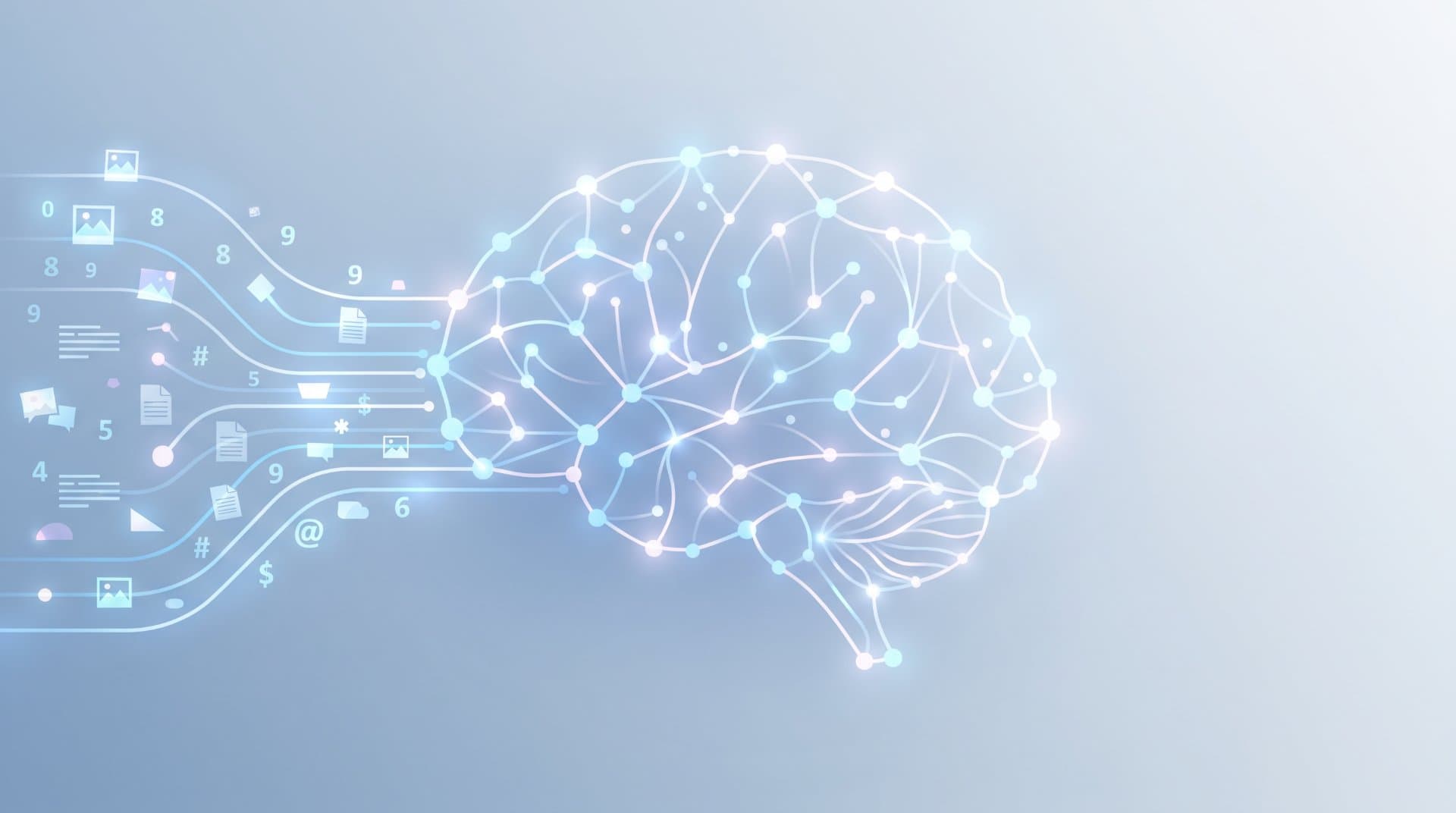
AI does not learn the way people do. It does not read a book and remember the ideas in it. It does not sit in a classroom and take notes. Instead, it looks at huge amounts of examples, tries to spot patterns in them and slowly adjusts itself until it gets better at a task.
This article explains that process in plain English. No coding background needed.
The Short Answer
AI learns by making guesses, checking how wrong those guesses are and adjusting itself to be less wrong next time. This happens millions or billions of times during training, using a large set of example data.
That is the whole idea in one sentence. The rest of this article breaks it down into smaller, easier pieces.
Step 1: It Starts With Data, Not Knowledge
An AI model starts out knowing nothing. It has no facts, no opinions and no understanding of the world. What it does have is a mathematical structure, usually called a neural network, that is ready to be shaped by data.
The data can be almost anything, depending on what the AI is meant to do:
Photos labeled "cat" or "dog" for an image recognition tool
Millions of sentences for a language model
Past medical scans paired with diagnoses for a healthcare tool
Historical prices for a financial forecasting tool
This data is called training data. The quality of this data matters more than almost anything else. If the data is biased, incomplete or wrong, the AI will learn those same flaws.
Step 2: The AI Makes a Guess
Once training starts, the AI looks at one example from the data and makes a guess. At the very beginning, this guess is essentially random, because the model has not learned anything yet.
For example, if the AI is shown a photo of a dog, it might guess "cat," "car," or anything else. It has no way of knowing which answer is correct.
Step 3: The Guess Is Checked Against the Right Answer
This is where training data becomes useful. Each example in the training set usually comes with the correct answer attached. In the photo example, the correct label would be "dog."
The AI compares its guess ("cat") with the correct answer ("dog") and calculates how far off it was. This difference is often called the error or the loss.
A small error means the guess was close. A large error means the guess was far off.
Step 4: The AI Adjusts Itself
This is the actual "learning" part.
Inside the AI model are millions (sometimes billions) of small internal settings, often called weights. These weights control how the model turns an input, like a photo, into an output, like a label.
After checking the error, the model slightly adjusts these weights so that next time, a similar input is more likely to produce the correct answer. This adjustment process is called backpropagation, paired with a method called gradient descent.
You do not need to remember those two names. The idea behind them is simple:
Find out which internal settings caused the mistake.
Nudge those settings in a direction that reduces the mistake.
Repeat.
Step 5: Repeat Millions of Times
One example and one adjustment barely changes anything. The real learning comes from repetition.
The AI goes through the training data again and again, sometimes seeing the same examples dozens of times. Each pass is called an epoch. With every pass, the errors get smaller and the model's guesses get more accurate.
This is also why training large AI models takes so much computing power. A model might need to process billions of examples before its guesses become reliable.
Step 6: Testing on New Data
Training is not the final step. After a model has learned from its training data, it needs to be tested on data it has never seen before. This is called test data.
This step matters because a model can sometimes memorize its training examples instead of actually learning the underlying pattern. This problem is called overfitting. A model that overfits performs well on data it has already seen but poorly on anything new.
Good AI training checks for this by holding back a portion of the data purely for testing, so the model's real-world performance can be measured honestly.
A Simple Example: Teaching AI to Recognize a Cat
To make this concrete, here is what actually happens when researchers train an AI to recognize cats in photos.
Thousands of photos are collected, some with cats and some without, all labeled correctly.
The AI looks at a photo and guesses "cat" or "not a cat."
The guess is compared to the correct label.
If wrong, the internal weights are adjusted slightly.
This repeats across thousands of photos, many times over.
Slowly, the model starts to associate certain patterns, such as pointed ears, whiskers and fur texture, with the label "cat."
The finished model is tested on new photos it has never seen, to check if the pattern-recognition actually works.
The AI never "understands" what a cat is in the way a person does. It has simply learned which visual patterns are statistically linked to the label "cat."
Why This Matters: AI Learns Patterns, Not Meaning
This is one of the most misunderstood parts of AI. A language model that writes fluent sentences has not learned facts the way a student learns facts. It has learned which words and phrases tend to follow other words and phrases, based on huge amounts of text.
This explains a few things people often notice about AI tools:
They can sound confident while being factually wrong, because confidence and accuracy are not the same statistical pattern.
They can struggle with topics that are rare in their training data.
They can reflect biases that existed in their training data, even without anyone intending that.
Understanding this helps set realistic expectations. AI is a pattern-matching system trained on data, not a system that reasons the way people do.
Common Mistakes People Make When Thinking About AI Learning
A few misunderstandings come up often and they are worth clearing up.
Mistake 1: Assuming AI learns continuously, like a person. Most AI models used in everyday tools do not keep learning after training ends. They are trained once (or retrained periodically), then used as a fixed system. Unless a company specifically updates and retrains a model, it will not "remember" new conversations or events on its own.
Mistake 2: Assuming more data always means a better AI. More data helps, but only if the data is relevant and accurate. Low-quality or biased data can make a model worse, even if there is a lot of it.
Mistake 3: Assuming AI understands what it is saying. An AI model can generate a correct medical explanation without "knowing" anything about medicine. It is producing text that statistically resembles correct answers it was trained on. This is why human review still matters for important decisions.
What Determines How Well an AI Learns?
A few factors matter more than others:
Data quality – accurate, relevant and well-labeled data leads to better learning than a large pile of messy data.
Data diversity – a model trained on a narrow slice of examples will struggle outside that narrow range.
Model design – some tasks need simpler models, others need much larger ones.
Training time and computing power – more training generally improves accuracy, up to a point, after which returns become smaller.
Testing and evaluation – without proper testing, it is hard to know if a model actually learned the right patterns.
Is This the Same for All Types of AI?
The general idea, guess, check, adjust, repeat, applies across most modern AI systems, including image recognition tools, recommendation systems and large language models. What changes is the type of data used and the specific structure of the model.
Simpler AI systems, like spam filters, use smaller amounts of data and simpler internal structures. Large language models use enormous amounts of text and far more complex internal structures. But the underlying learning process follows the same basic pattern described above.
Frequently Asked Questions
Does AI learn in real time while people are using it? Usually not. Most AI tools are trained beforehand and do not change their internal settings during normal use. Any updates typically happen through a separate retraining process handled by the developers.
Can AI learn from bad or biased data? Yes. If the training data contains errors, gaps or bias, the AI is likely to reflect those same issues in its outputs. This is why data quality is treated as a serious concern in AI development.
Does more training data always improve an AI model? Not always. Relevant, accurate and well-labeled data tends to help. Large amounts of irrelevant or poor-quality data can actually make a model less reliable.
Is AI learning the same as human learning? No. AI learning is based on statistical pattern recognition across large datasets. Human learning involves reasoning, context and lived experience in ways current AI systems do not replicate.
What to Take Away From This
AI does not learn through understanding. It learns through repeated exposure to examples, constant small corrections and statistical pattern recognition across huge datasets. Knowing this helps explain both what AI is genuinely good at, like spotting patterns across large amounts of information and where it can fall short, like reasoning through situations it has not seen much of before.
If you are evaluating an AI tool for a project, the most useful question is not "how smart is this AI," but "what data was it trained on and how well does that data match what I actually need it to do."
Related Topics:
Share this story with your network
Direct citation and sharing for this investigative report.

Afshan Yasmeen
Writer
Afshan Yasmeen is a writer and independent content creator who shares useful, well-researched, and easy-to-understand articles on her website. She enjoys exploring different topics, learning new things, and turning her research into practical information that readers can actually use. Her writing focuses on clarity, honest information, and a simple human style. She takes the time to research topics carefully and aims to explain even complex subjects in a way that feels natural and easy to follow. Through her website, Afshan shares her knowledge, ideas, findings, and helpful guides with readers from different backgrounds. Her goal is simple: to create content that is genuinely useful, trustworthy, and worth reading.
Related Coverage & Dispatches
More in Technology →
Why Your Phone Storage Fills Up So Quickly and How to Free Space
Explains why phone storage gets full even when you did not install anything new, including photos, app cache, System Data and hidden trash folders. Gives simple steps to free space on iPhone and Android and what to do when nothing seems to work.
 View Point SpotOct 5, 2026

What to Do When a Software Update Makes Your Device Slower
Many people see their phone or computer become slow right after a software update. This article explains why it happens, which slowdowns are normal and go away alone and which need action. It gives simple steps for iPhone, Android and Windows, plus mistakes to avoid and when to ask for help.
View Point SpotOct 5, 2026
Internet Provider Keeps Raising Your Bill? Here Is What You Can Do
This article explains why internet providers raise prices again and again and what you can do about it. It covers reading your bill, finding the real reason for the increase, asking for a better deal, lowering your plan and switching provider. It also explains the mistakes people make when they negotiate.
View Point SpotOct 5, 2026Reader Discussion (0)
No comments yet. Be the first to start the discussion!